
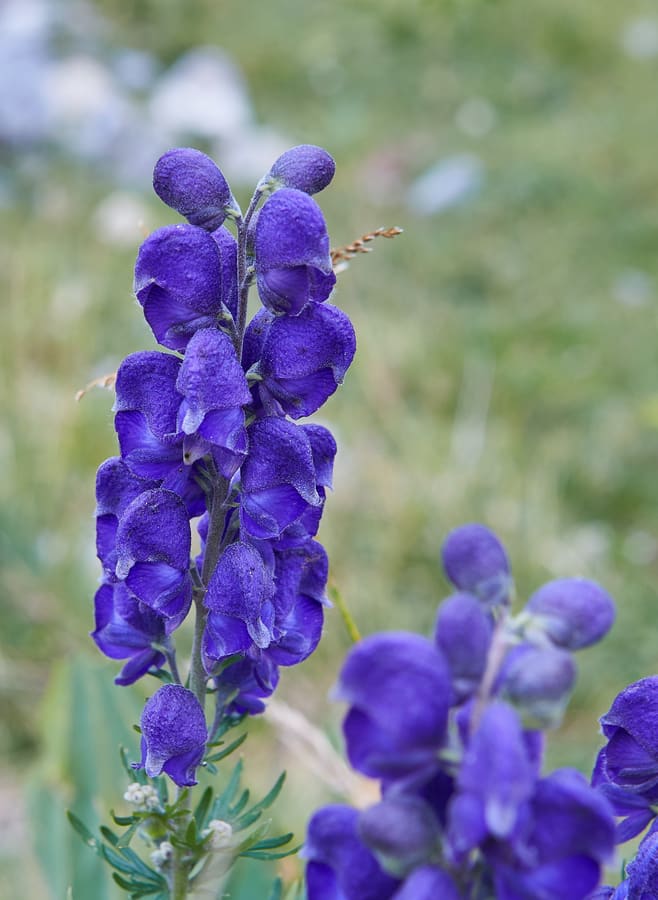
Aconite (Aconitum napellus)
Photo: Axel Tschentscher · CC BY-SA 4.0
- Licensed photo
Overview
Aconite (Monkshood) is a perennial herb growing up to about 5 ft (1.5 m). It has dark green, deeply lobed leaves and violet or blue flowers on long, upright spikes, resembling delphiniums.
Traditional uses & properties
It contains terpenoid alkaloids, principally aconitine. In Ayurvedic medicine, Aconite has been used for neuralgia, asthma, and heart weakness (in extremely minute, carefully prepared doses), and it is also employed in homeopathy for analgesic and sedative purposes.
Traditional preparations
Preparation amounts are not shown for this herb. It is toxic, restricted, or otherwise unsafe to self-dose - the margin between a traditional dose and a harmful one is too small to publish as reference material. If you are considering it, that conversation belongs with a doctor or a qualified practitioner, not a website.
Safety & precautions
Aconite is highly toxic in all but the smallest doses and is subject to legal restrictions in some regions. It is rarely given internally and should only be used with professional supervision. It is more often applied externally (on unbroken skin) to relieve certain types of pain.
Drug & food interactions
Interaction data is not available for this herb - talk to a pharmacist before combining it with any medication. A blank entry here means we have not documented interactions, not that none exist.
Habitat
It grows mainly in southern and central Europe, preferring damp, shady locations, and is also cultivated as a garden plant. The root is traditionally dug up in autumn.
Frequently asked questions
What is Aconite (Aconitum napellus) traditionally used for?
Traditional sources describe Aconite (Aconitum napellus) as follows: It contains terpenoid alkaloids, principally aconitine. In Ayurvedic medicine, Aconite has been used for neuralgia, asthma, and heart weakness (in extremely minute, carefully prepared doses), and it is also employed in homeopathy for analgesic and sedative purposes.
How is Aconite (Aconitum napellus) prepared?
Preparation amounts are not shown for this herb. It is toxic, restricted, or otherwise unsafe to self-dose - the margin between a traditional dose and a harmful one is too small to publish as reference material. If you are considering it, that conversation belongs with a doctor or a qualified practitioner, not a website.
What safety cautions apply to Aconite (Aconitum napellus)?
Aconite is highly toxic in all but the smallest doses and is subject to legal restrictions in some regions. It is rarely given internally and should only be used with professional supervision. It is more often applied externally (on unbroken skin) to relieve certain types of pain.