
Herbs for Urethritis
6 herbs traditionally used for this condition.
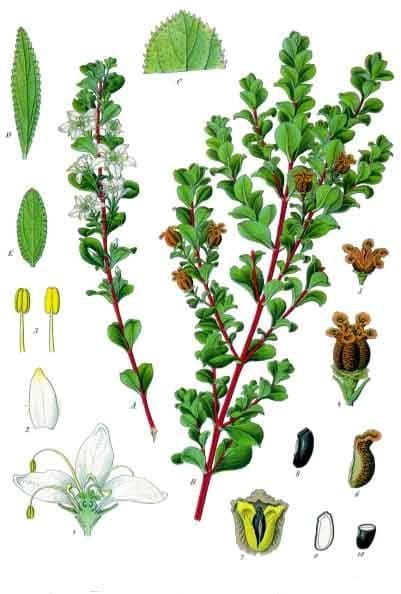
- Buchu (Barosma betulina)
Buchu is a strongly aromatic, bushy shrub reaching about 6½ ft (2 m), with slightly leathery, dotted leaves that release a distinctive scent. Indigenous peoples of South Africa have long valued buchu as a general stimulant, diuretic, and digestive aid. In contemporary Western herbal medicine, it is prized mainly as a urinary antiseptic and diuretic, traditionally employed for cystitis, bladder infections, irritable bladder, and sometimes prostatitis.
- Pipsissewa (Chimaphila umbellata)
Pipsissewa (Chimaphila umbellata) is an evergreen plant about 8 in (20 cm) tall, with glossy, wedge-shaped leaves and small, pinkish-white flowers in flat-topped clusters. A close relative of uva ursi, pipsissewa shares urinary antiseptic properties and is notably gentler on the kidneys.
- Couch Grass (Elymus repens)
Couch grass is a vigorous perennial growing to 32 inches with a long, creeping rhizome, slender leaves, and erect spikes bearing green flowers aligned in two rows. Found in Europe, the Americas, northern Asia, and Australia, it is an invasive weed harvested throughout the year. In classical times, both Dioscorides (40–90 CE) and Pliny (23–79 CE) recommended couch grass root for poor urine flow and kidney stones. The herbalist John Gerard wrote in 1597 that 'Couch-grasse be an unwelcome guest to fields and gardens, yet his physicke virtues do recompense those hurts; for it openeth the stoppings of the liver and reins [ureters] without heat.' In times of famine, the root was roasted and ground as a substitute for coffee and flour.
- Goldenrod (Solidago virgaurea)
Goldenrod is a perennial plant growing to 28 inches with toothed leaves and branched spikes of golden-yellow flowers. Native to Europe and Asia and naturalized in North America, it prefers open areas and hillsides and is gathered in summer while in flower. The herbalist John Gerard commented wryly in 1597 about how goldenrod's value plummeted once it was discovered growing locally in Hampstead wood, London, noting society's tendency to esteem things only while they remain rare and foreign. Four hundred years later, this observation still rings true, though the herb's genuine therapeutic value remains unchanged.
- Gravel Root (Eupatorium purpureum)
Gravel root is an erect perennial growing to 5 feet with whorls of pointed oblong leaves and clusters of purple-pink florets. Native to eastern North America, the root is unearthed in autumn. The plant's alternative name, Joe Pye weed, honors the Native American said to have used it to cure New Englanders of typhus. Native Americans valued the herb as a diuretic and remedy for genitourinary conditions, and the root was listed in the Pharmacopoeia of the United States from 1820 to 1842, attesting to its recognized medicinal importance.
- Uva Ursi (Arctostaphylos uva-ursi)
Uva-ursi is a low-lying evergreen shrub growing to 20 inches tall with long trailing stems, dark green leaves that are glossy on the upper side, bell-shaped pink flowers, and small glossy red berries. The name means 'bear's grape' in Latin, as bears are fond of the fruit. Native to Europe and naturalized throughout the northern hemisphere up to the Arctic, it grows in damp undergrowth, heathland, and grassland conditions. The plant was first documented in The Physicians of Myddfai, a 13th-century Welsh herbal text.